Tahajjud Guide & 30-Night Tracker
Learn when and how to pray the night prayer, then track 30 nights to make it a habit.
Updated 25 October 2026
 5 pagesGuide
 A4 & US Letterprint at home
 Everyonebest for
 5 minutes to read, 30 nights to build thtime it takes
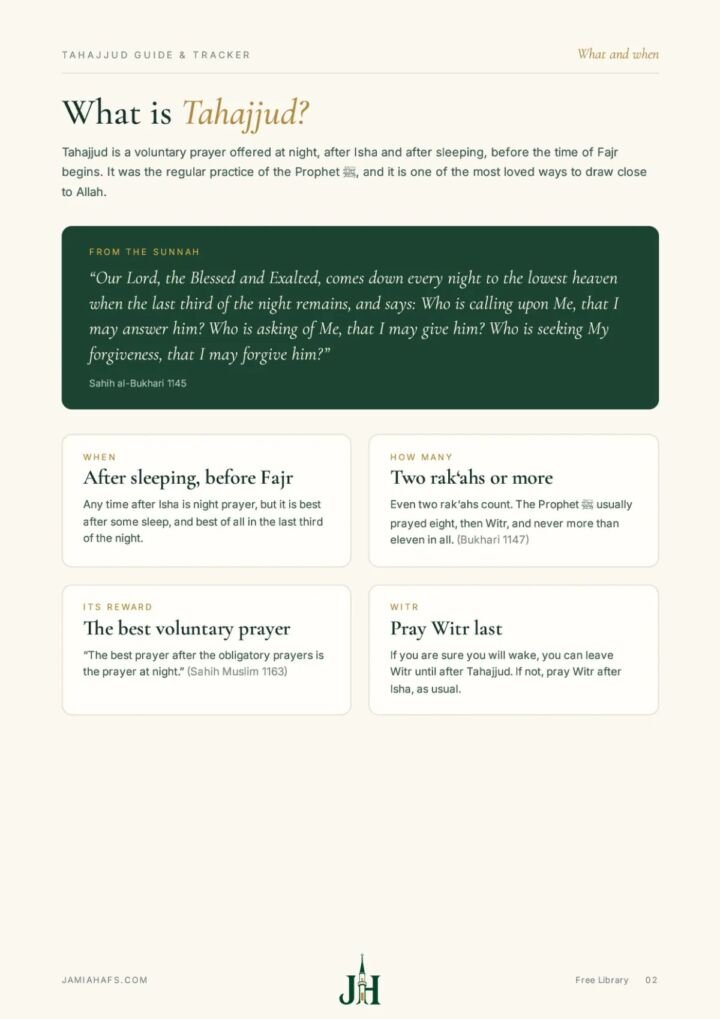
Tahajjud is a voluntary prayer offered at night, after Isha and after sleeping, before the time of Fajr begins. It was the regular practice of the Prophet ﷺ, who said: "The best prayer after the obligatory prayers is the prayer at night." (Sahih Muslim 1163). He also told us that Allah comes down to the lowest heaven in the last third of every night, asking who is calling upon Him so that He may answer (Sahih al-Bukhari 1145). This guide explains when to pray, how many rak'ahs to offer and how to pray step by step according to the Hanafi school. It ends with a 30-night tracker so you can start small and stay consistent.
Step by step
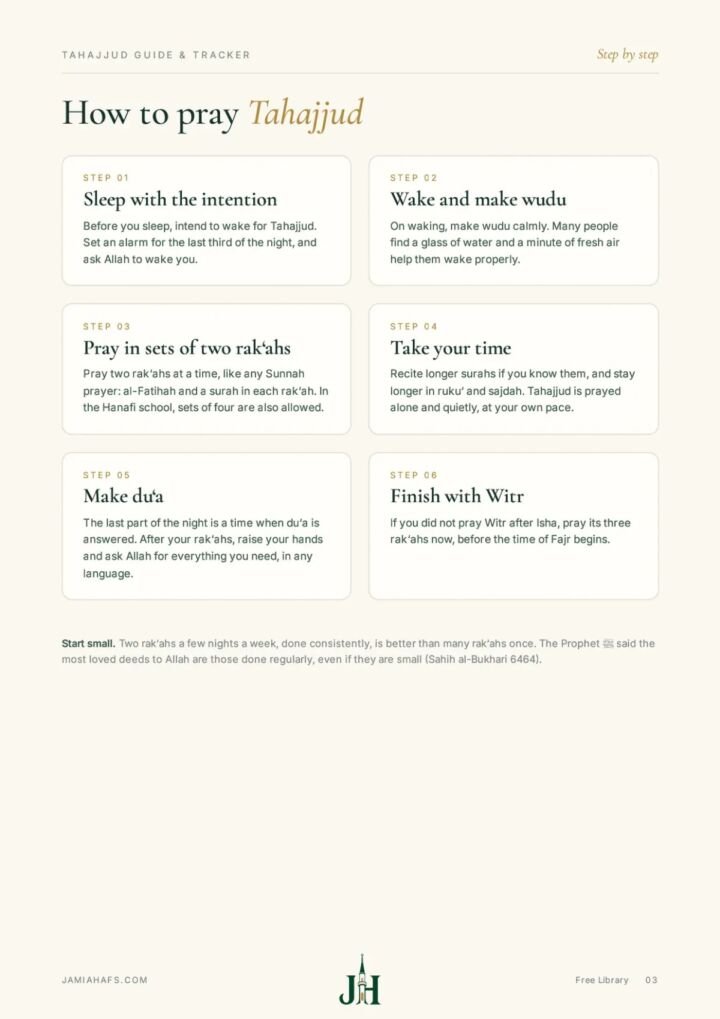
- 1Sleep with the intention to wake, and set an alarm for the last third of the night
- 2Wake up and make wudu calmly
- 3Pray in sets of two rak'ahs, reciting al-Fatihah and a surah in each rak'ah
- 4Take your time: recite longer surahs and stay longer in ruku' and sajdah
- 5Make du'a, as the last part of the night is a time when du'a is answered
- 6Finish with Witr if you did not pray it after Isha
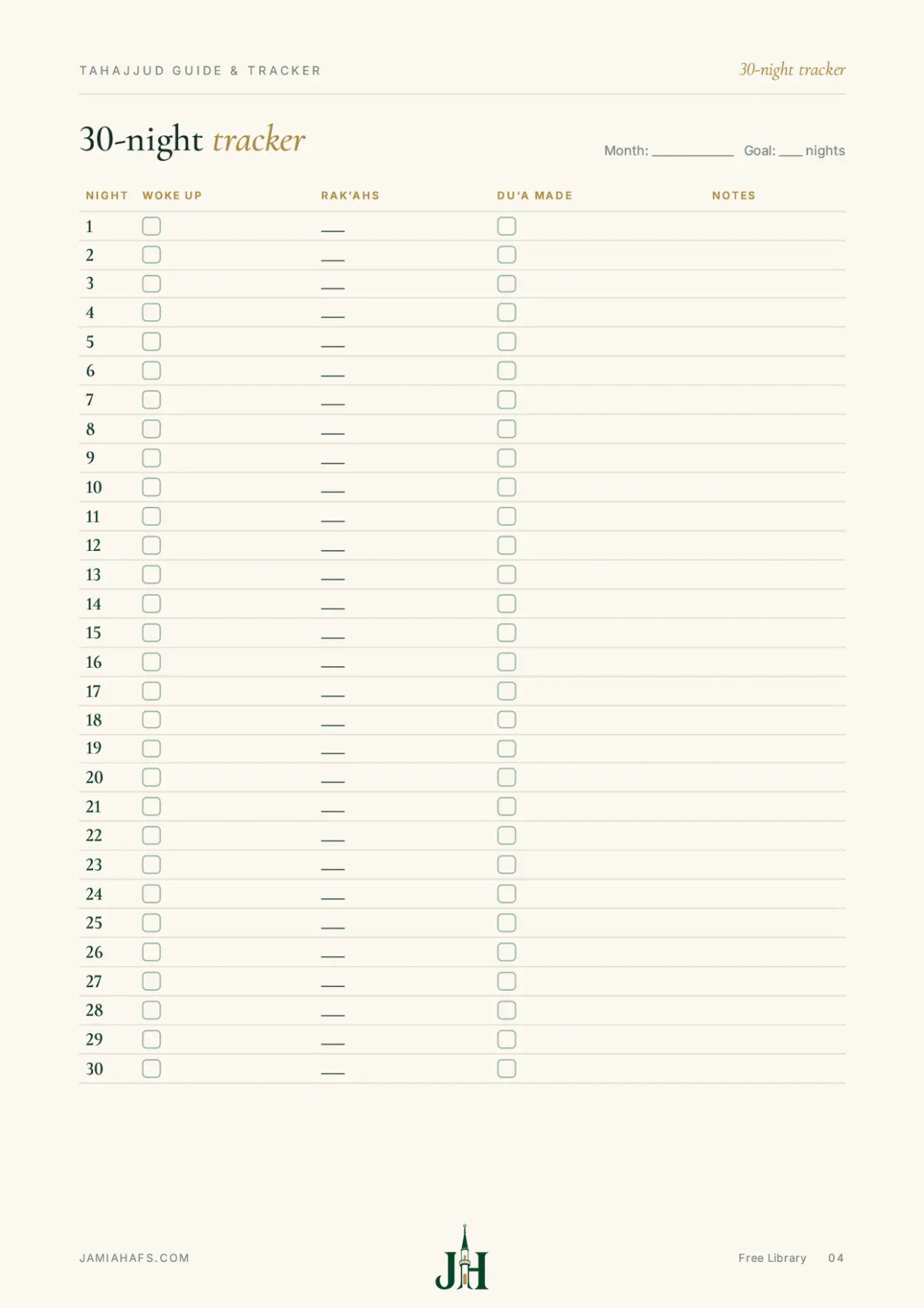
- 7A 30-night tracker to record the nights you woke, rak'ahs prayed and du'a made
Start small
Two rak'ahs a few nights a week, done consistently, is better than many rak'ahs once. The Prophet ﷺ said the most loved deeds to Allah are those done regularly, even if they are small (Sahih al-Bukhari 6464). Print the tracker page again each month and keep going.
Peek inside
How to use it
Read the guide once, then set a simple goal on the tracker, such as two rak'ahs on three nights a week. Keep the tracker by your bed with a pen. Each morning, tick the nights you woke, write how many rak'ahs you prayed and whether you made du'a. When the month ends, print a new tracker and raise your goal a little.
Learn the Qur'an live with a teacher
Live online classes taught in Urdu / Hindi, for children and adults. Your first class is free, with no payment needed.
Your first class is free. No payment needed.
Frequently asked questions
What time is Tahajjud prayed?
Any time after Isha until Fajr begins, but it is best after some sleep, and best of all in the last third of the night.
How many rak'ahs are there in Tahajjud?
At least two. The Prophet ﷺ usually prayed eight, then Witr, and never more than eleven in all (Sahih al-Bukhari 1147).
Do I have to sleep before praying Tahajjud?
Tahajjud is the prayer offered after sleeping. Any voluntary prayer after Isha is night prayer, but praying after some sleep is what makes it Tahajjud.
Should I pray Witr before or after Tahajjud?
If you are sure you will wake, you can leave Witr until after Tahajjud. If not, pray Witr after Isha as usual.
Can I make du'a in my own language during Tahajjud?
Yes. After your rak'ahs, you can raise your hands and ask Allah for anything you need, in any language.
How does the tracker work?
It has 30 rows, one per night. Tick whether you woke, write how many rak'ahs you prayed, tick if you made du'a, and add any notes. Print it again each month.
Was this sheet helpful?
What would make it more useful? (optional)
JazakAllahu khayran. Your answer helps us decide what to make next.
Looking for another sheet?
More free printables


Take the next step with Jamia Hafs
Live online classes in small groups, with individual attention for every student. Taught in Urdu and Hindi, for students in India. Female teachers are available for sisters.
Made with care by the teachers at Jamia Hafs.